Based on the floor of Korea's government Autonomous Factory Program site (Speefox, selected 2025), this page opens up the full closed loop — from data collection to production operations, stage by stage. Not a concept: the actual process we are implementing on a verified site.
The state of the physical plant streams into its digital twin in real time, and AI decisions made in the virtual plant return — after verification — as control commands on real machines. This bi-directional closed loop is the skeleton of a dark factory, and the four stages below cycle through it without pause.
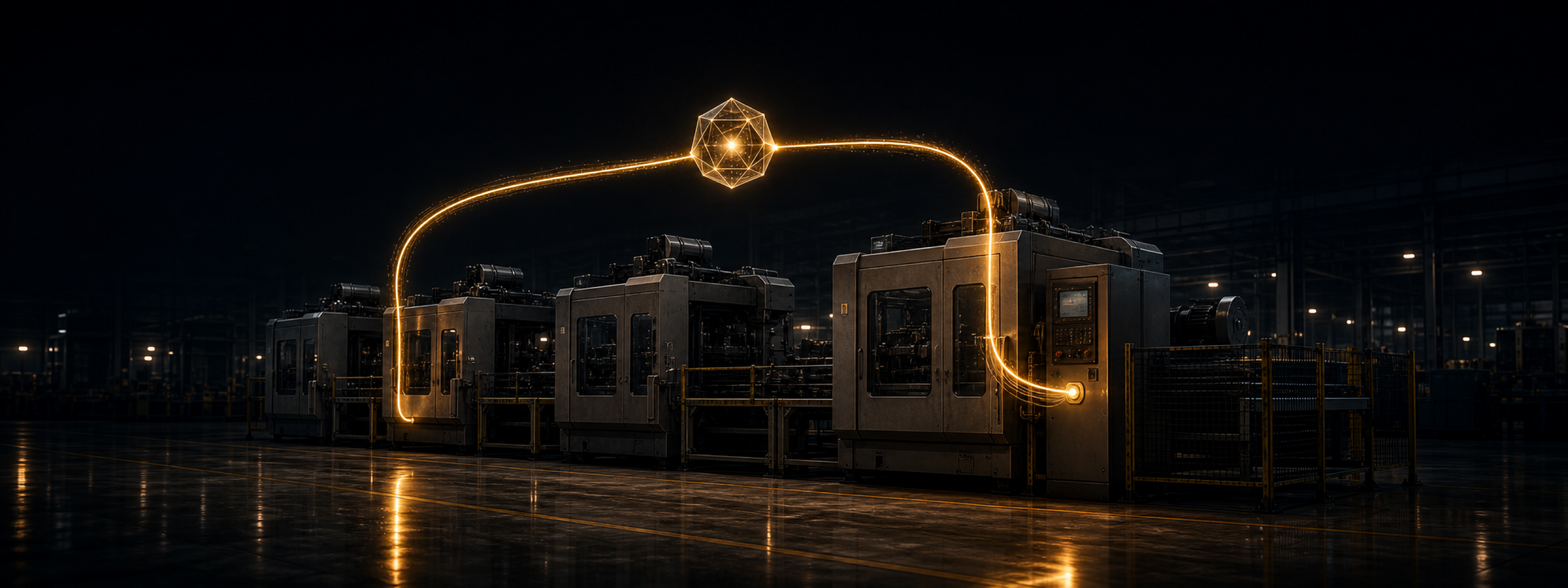
FIG — THE LOOP SIMPLY RUNS
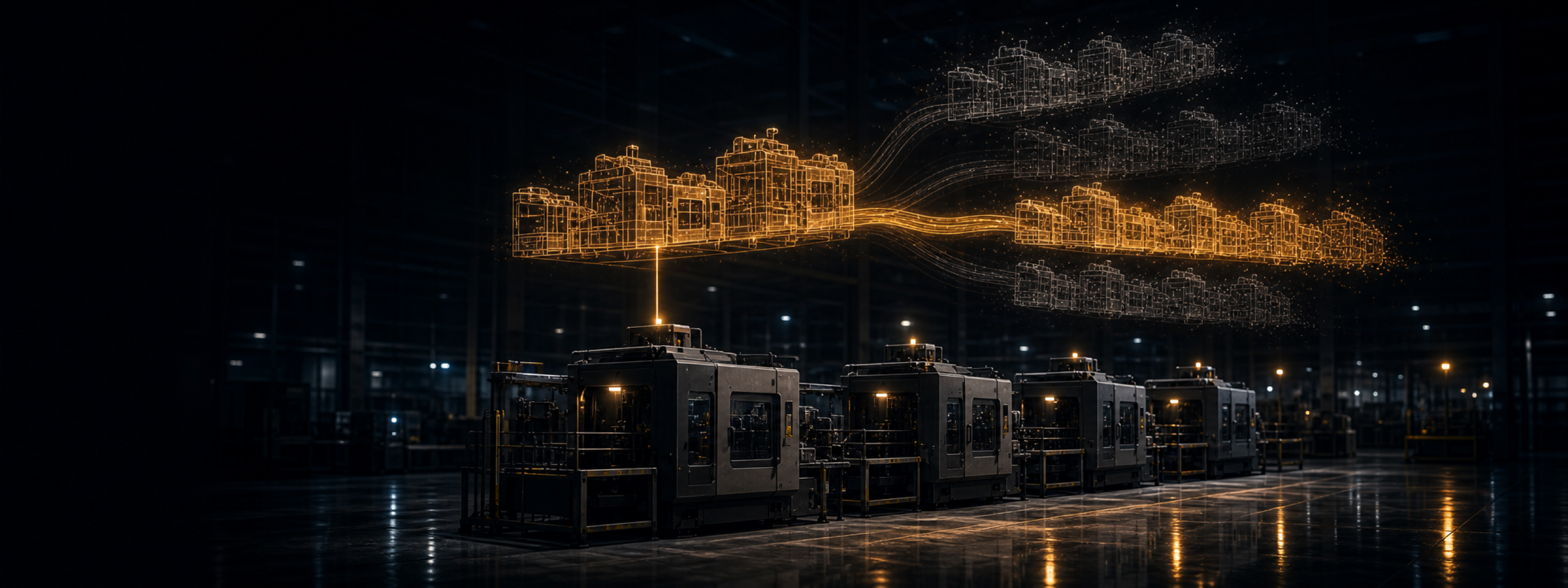
FIG — TWO SOURCES, ONE STREAMA dark factory starts with data. On the Speefox program site we connect 243 PLCs — 186 finishing presses plus semi-finished, heat-treatment, de-oiling, washing and drying equipment — and collect the floor's signals in three levels: from field PLCs and sensors to process edge nodes, and from the edge to the plant data warehouse and lake.
Heterogeneous equipment is the real obstacle: every machine speaks a different protocol. An edge gateway unifies everything from direct-wired RS-485/RS-232 PLCs to OPC-UA and TCP/IP, and the collected data is organized into AAS (IEC 63278) standard asset models — so every value carries meaning: which machine, which parameter.
Machine signals alone are not enough — what to build, and by when, lives in the business systems. So we also connect orders, production plans, BOMs and work instructions from MES and ERP, putting the floor's current state and production's targets on one data foundation.
FIG — THE FUTURE IS TESTED FIRSTOn top of the collected data, the AI makes its decisions. The starting point is the production plan: taking orders, due dates and BOMs from ERP and MES as input, it optimizes what to build, when, and in what sequence — then validates that plan virtually before anything runs. One principle governs everything: no decision touches a machine before it has been verified in the virtual plant.
A hybrid simulation engine combining DES (discrete-event) and ABS (agent-based) compares What-If scenarios in parallel — machine breakdowns, material delays, rush orders, bottlenecks — to pre-verify each decision. Simulation accuracy was certified at 85% by an accredited testing body (a composite of time, resource and output accuracy), and ML-based parameter calibration keeps closing the gap with the real floor. The whole plant is visualized as a browser-based Unity 3D digital twin, synchronized with the floor at the 100ms level (in rollout).
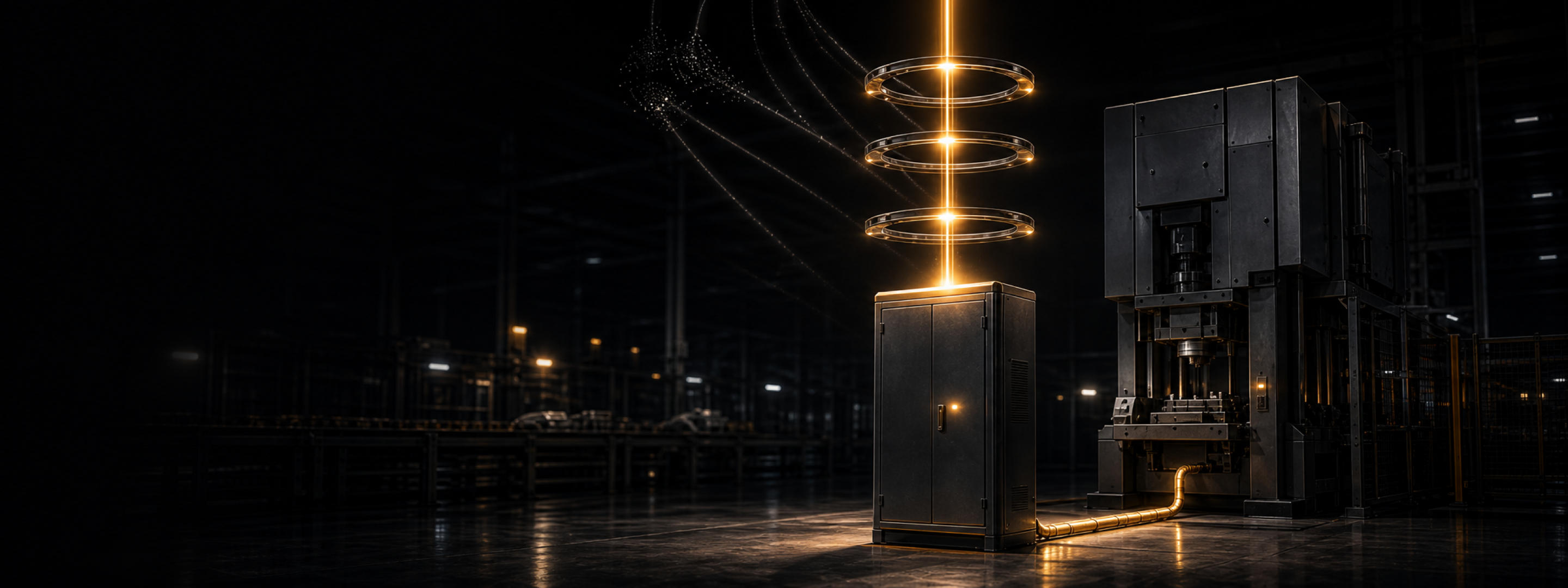
FIG — ONLY WHAT PASSES MAY COMMANDThis is where a simulation-approved decision reaches real equipment — through a double safety layer. Commands that would violate physical constraints are blocked by rule checks before execution, and control authority itself is handed over stepwise through the AAF framework (L0–L4), only as far as it has been verified. First the AI only judges (Shadow Mode); once its agreement rate is proven, it moves to approve-then-execute; only then to bounded autonomous execution.
This AI-to-PLC direct-control path has been demonstrated on physical equipment, and on the Speefox site we demonstrated simultaneous synchronization of 186 presses, 25 AMRs and 6 EMS units (the AMRs and EMS are the customer's existing equipment, integrated under AI supervision).
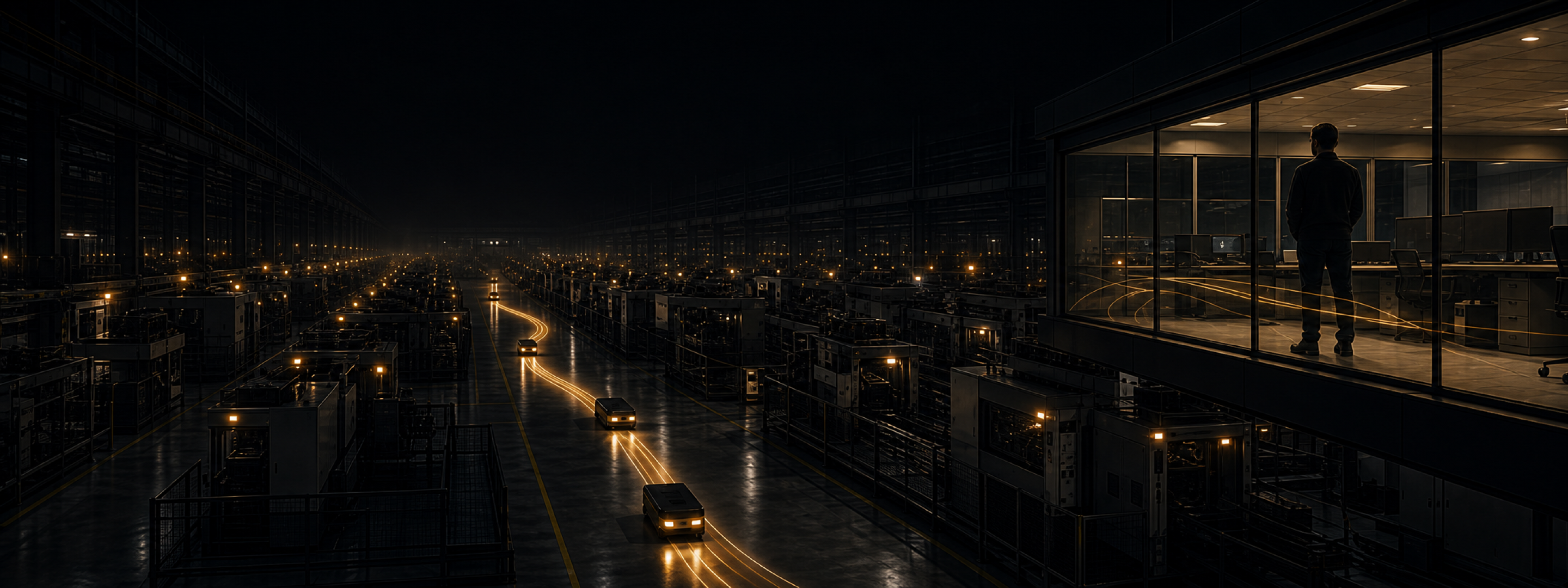
FIG — THE FACTORY RUNS IN THE DARKWhen the four stages connect, the plant runs like this: an anomaly is detected, the AI analyzes the cause, validates a response in simulation, reschedules production and redeploys machines and logistics. The whole cycle plays out live on the digital twin in the control room.
The human role changes — from a watcher of every machine to a decision-maker who handles the exceptions and approval requests the AI raises. New equipment and policy changes are tested by virtual commissioning before anyone touches the real line, eliminating the cost of failure. When judgment accuracy wavers, drift detection triggers MLOps retraining automatically.
None of the above is a one-off build. The 2026 program site (Chexcar, used-car remanufacturing) is being built by transplanting the same stack from Speefox — proof that one stack handles both high-volume repetitive production and high-mix, per-vehicle judgment.
We diagnose your current equipment and data, then design the starting stage with you.